Twenty-four years ago this very week, a man named Steve Fossett was floating somewhere over the open ocean, alone in a balloon, being hurled along at nearly 200 miles per hour. Most mornings over Sonoma, our team travels about a hundred and ninety miles per hour slower than that — and honestly, that’s the whole point.
It’s one of the questions we get asked most often at the launch field, usually right after how high do we go? So how fast do hot air balloons go? The short answer is delightfully simple: a hot air balloon travels at exactly the speed of the wind. On a calm wine-country sunrise, that’s a gentle 5 to 15 miles per hour — slower than you’d ride a bicycle. But the longer answer, the one that involves the jet stream and a couple of genuinely jaw-dropping records, is a lot more fun. Here’s everything you actually want to know, from a team that drifts over Carneros most mornings of the year.
The short answer: as fast as the wind, and not a bit faster
A hot air balloon has no engine, no propeller, and no steering wheel. It can’t push itself forward the way a plane or a helicopter does. Instead, it simply becomes part of the air around it and goes wherever that air is going, at whatever speed that air is moving.
That means a balloon’s “ground speed” is really just the wind speed. For a typical scenic flight, you can expect:
- Around 5 to 15 mph on most mornings — a slow, dreamy drift across the landscape.
- Closer to 3 to 8 mph on the calmest sunrises, when the air barely stirs and the balloon seems to hang in place over the vineyards.
- A hard stop well below 25 mph at the surface, because we simply don’t launch when the winds are too strong (more on that below).
A balloon on a calm morning moves at about the pace of a brisk walk — one of the few ways to travel where the entire appeal is not getting there quickly.
Why you’ll never actually feel that speed
Here’s the part that surprises nearly every first-time flyer, and it’s our favorite thing to explain. Even when a balloon is moving across the ground at 12 or 15 mph, you won’t feel a single breath of wind in your face. There’s no rushing air, no flapping jacket, no flag snapping in the breeze.
Why? Because you are the wind. The balloon, the basket, you, and the air all around you are one big system, drifting together at the same speed in the same direction. With no relative motion between you and the air, there’s nothing to feel. The burner flame rises straight up. A held-out scarf hangs limp. Some pilots like to point out that you could hold a lit candle over the edge and the flame would barely flicker.
The only time you’ll sense any breeze is in the brief moments a pilot is climbing or descending between two layers of air moving differently — and even that is subtle. This is exactly why guests who tell us they’re nervous about heights so often forget to be scared. You’re not fighting the sky; you’re floating with it — nothing like the stomach-drop of a roller coaster.
How fast do we actually go over Sonoma wine country?
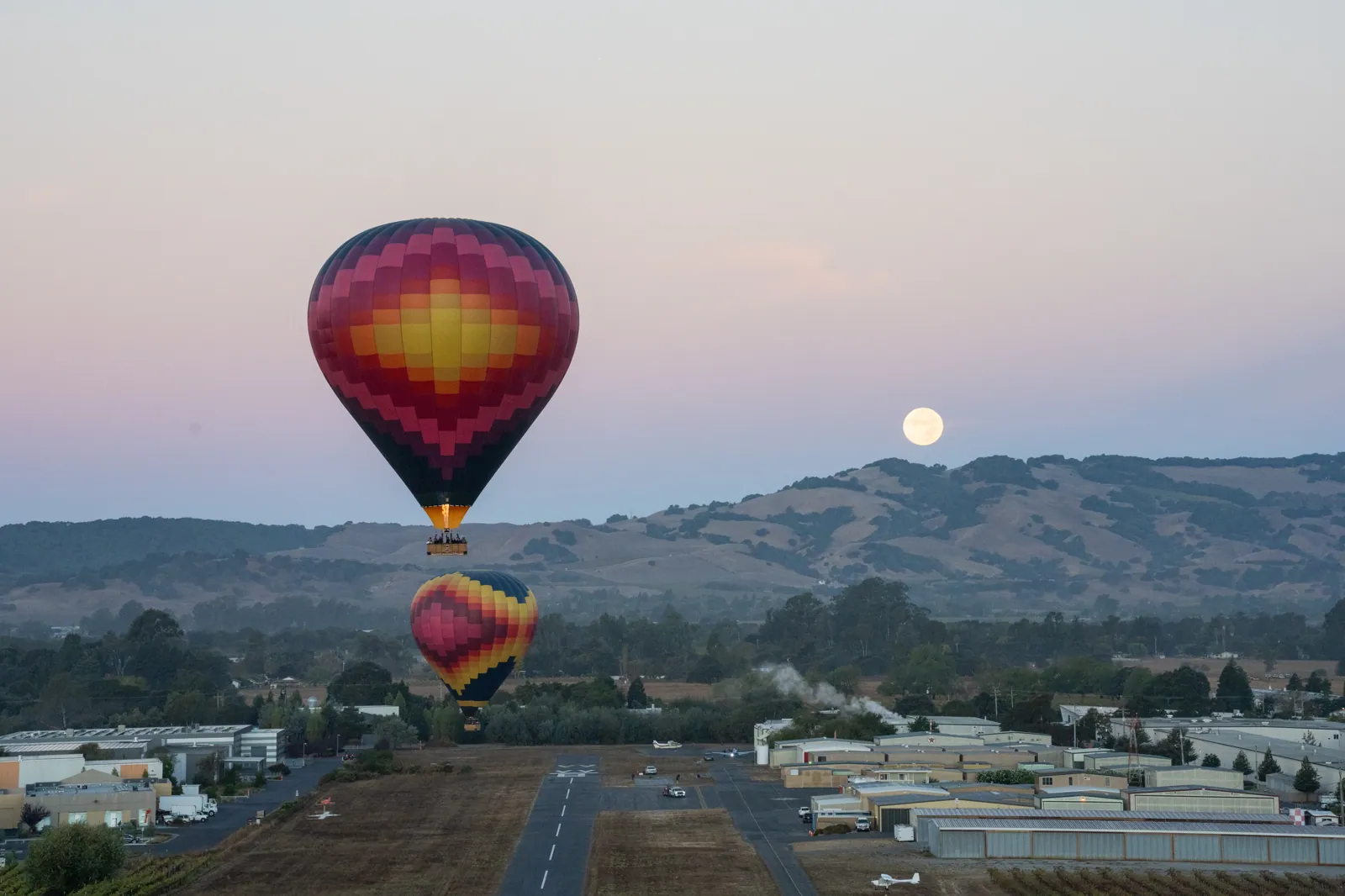
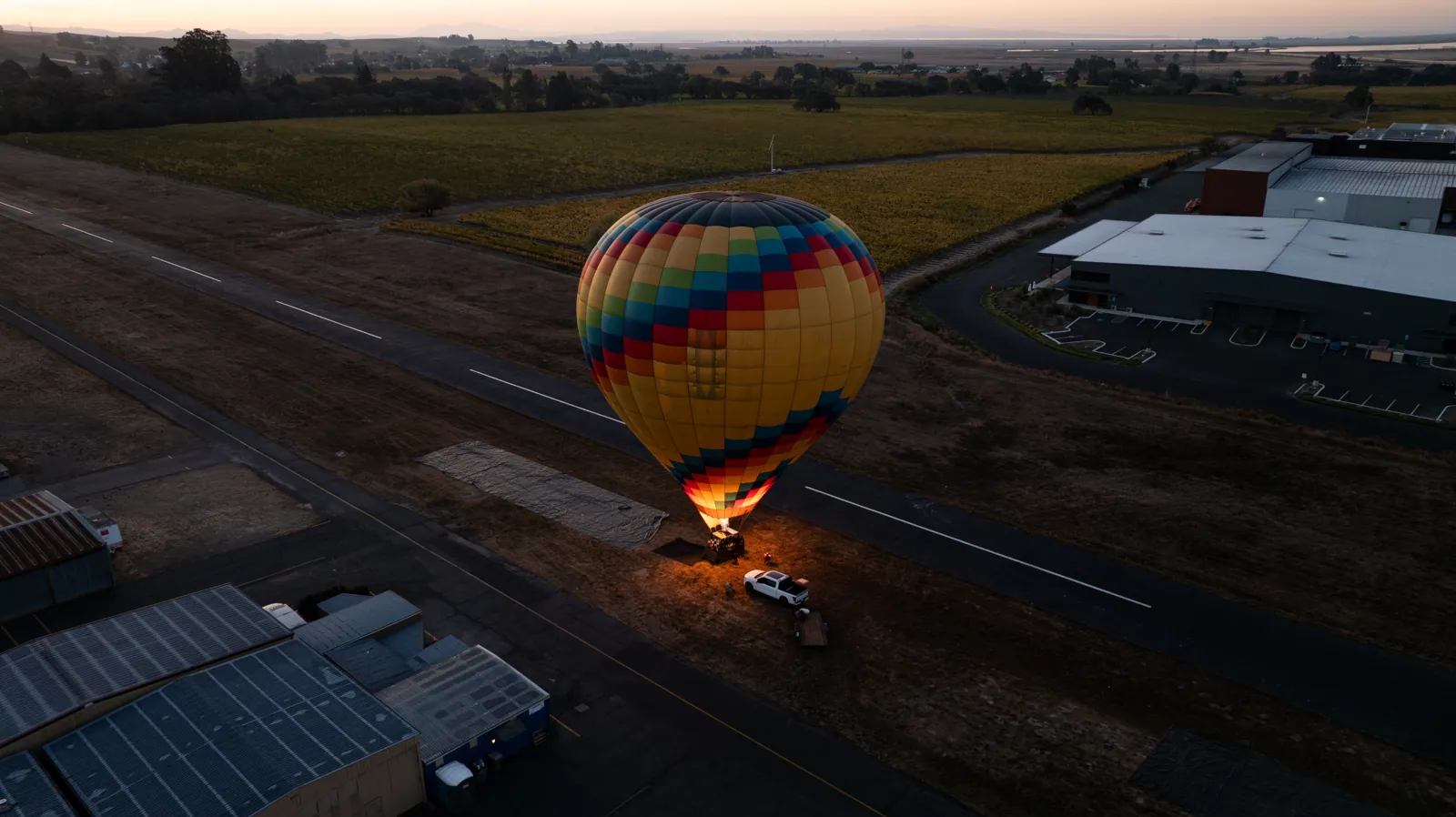
Most of our flights drift somewhere in that gentle 5-to-15 mph range, and the precise number depends entirely on the morning. Because we launch from our home base at Sonoma Skypark and partner sites around Carneros and the Sonoma Valley, we have the flexibility to pick the best conditions rather than forcing a flight on a windy day.
We fly at sunrise for a reason, and speed is a big part of it. The air is at its calmest and most stable in the first hour after dawn, before the sun heats the ground and stirs up gusts and thermals. That’s what gives you the smooth, slow, postcard-perfect drift that wine country is famous for. (We go deep on this in Why Most Hot Air Balloon Rides Happen at Sunrise.)
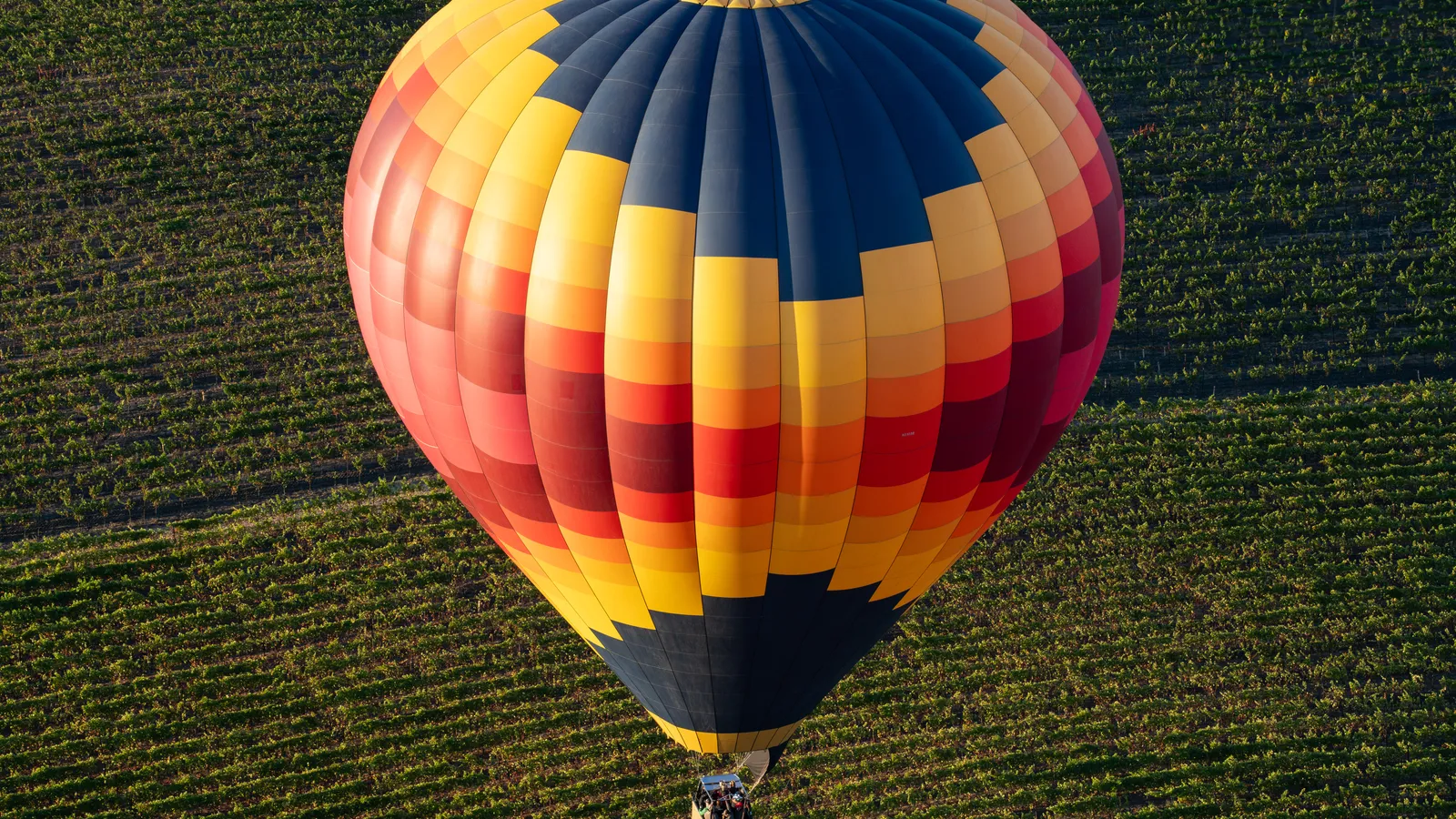
A slow pace is also what makes the views worth waking up early for. At a walking-speed drift you have time to actually take in the patchwork of vineyards below, watch a hawk ride the same air you’re in, and pick out the Mayacamas ridgelines and — on the clearest mornings — the San Francisco Bay in the distance. It pairs perfectly with the part of the morning everyone remembers: the complimentary champagne toast when we land, a tradition we’re proud to be the only company in the area still keeping alive.
So how did a balloon ever hit 200 mph?
If balloons just drift with the wind, how on earth did Steve Fossett get to nearly 200 miles per hour? One word: the jet stream.
High up in the atmosphere — five, six, seven miles above the ground — there are rivers of air that howl along at well over 100 mph. A balloon can’t generate its own speed, but if it climbs high enough to catch one of those currents, it will be carried along just as fast as that air is moving. Long-distance record balloons are built specifically to ride them. Here are two flights worth knowing about:
- Steve Fossett’s Spirit of Freedom (2002). Fossett launched from Northam, Western Australia on June 19, 2002, and landed back in Australia on July 3 — 13 days, 8 hours, and 33 minutes later, having covered more than 20,600 miles. It made him the first person ever to fly solo, nonstop, and unrefueled around the world in any aircraft, and it took him six tries to do it. His top speed over the Indian Ocean reached about 186 mph, with the jet stream pushing him near 200 mph at times.
- The Breitling Orbiter 3 (1999). Three years earlier, Bertrand Piccard and Brian Jones made the first nonstop balloon flight all the way around the globe. They lifted off from the Swiss village of Château-d’Oex on March 1, 1999, and came down in the Egyptian desert on March 21 — nearly 20 days aloft and more than 25,000 miles, reaching speeds around 142 mph and altitudes near 38,500 feet.
These weren’t sightseeing balloons, of course. They were sealed, pressurized, high-tech capsules built to survive thin air and brutal cold for weeks at a time. But they prove the same principle that governs your gentle morning over Sonoma: a balloon goes exactly as fast as the air it’s riding. Pick calm air near the ground and you drift; climb into the jet stream and you can outrun a highway. That little fact is also a fun one to argue about over the champagne toast.
How pilots “choose” their speed and direction
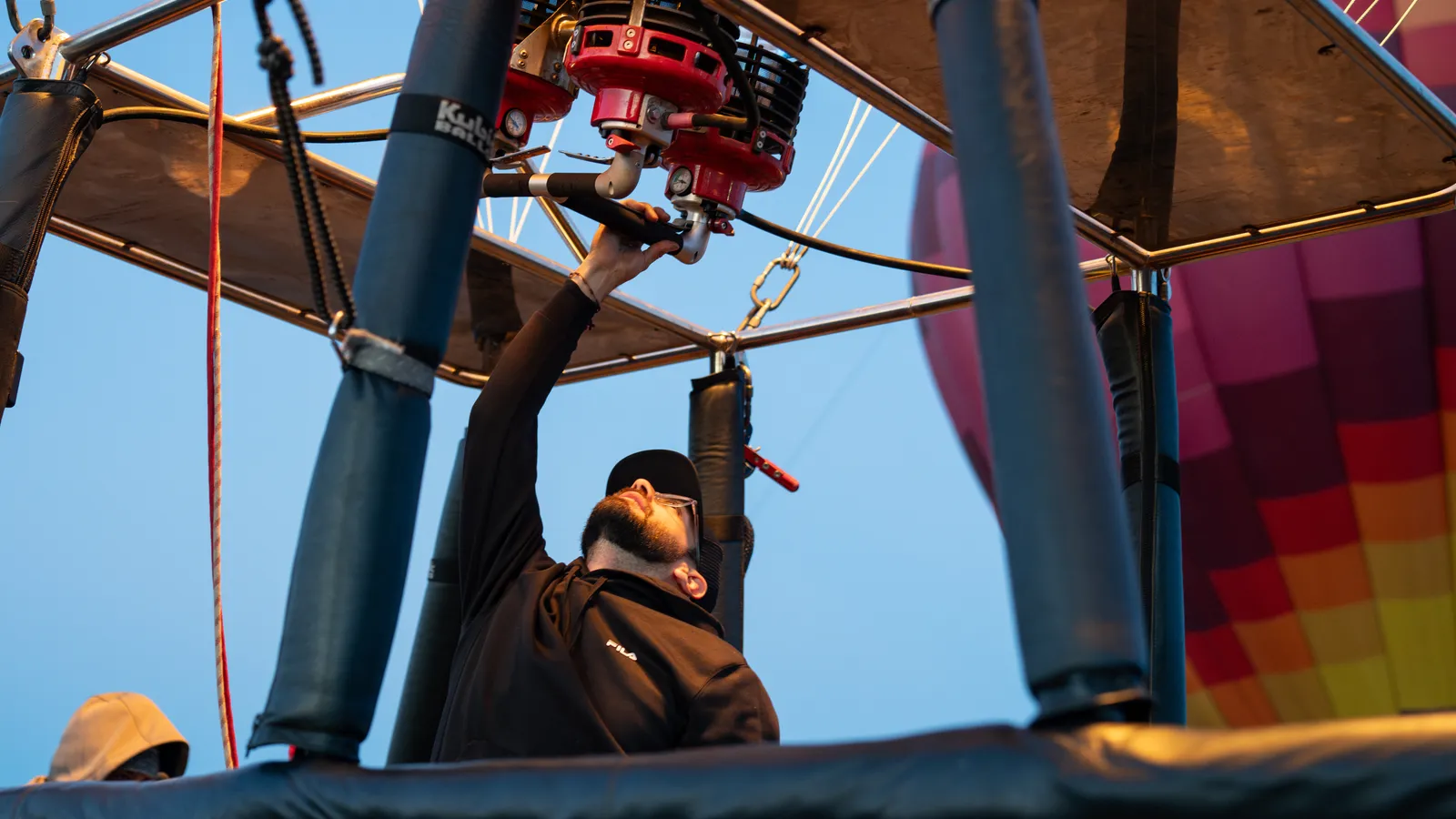
Since a balloon can’t steer itself, you might wonder how we get anywhere on purpose. The trick is one of the most elegant things in aviation: at different altitudes, the wind is usually blowing in slightly different directions and at different speeds. By heating the air to climb or venting to descend, a pilot moves the balloon up or down until it finds a layer headed the right way — essentially shopping through a stack of winds.
So when a pilot wants to slow down, speed up, or change course, the move is always vertical. Climb a few hundred feet to catch a faster, different breeze; settle lower to find the slow, calm air for an intimate pass over the vines. It looks like magic from the basket, but it’s really just a deep familiarity with how the local winds stack up on any given morning. We unpack the whole counterintuitive trick in How Does a Hot Air Balloon Steer?, and how altitude plays into it in How High Do Hot Air Balloons Fly?
What about up and down? How fast do balloons climb?
Horizontal drift is only half the story. A balloon also moves vertically, and here too the pace is gentle — you’ll rise and settle at a leisurely few hundred feet per minute, slower and smoother than a typical elevator. A skilled pilot makes these changes so gradually that you’ll often glance down and realize you’ve climbed a thousand feet without noticing.
The same controls can move a balloon up or down more briskly when needed, which matters most near landing. Coming back to earth, our FAA-certified pilots manage the descent with small, deliberate burns so the touchdown is soft and controlled. Smooth in every direction is the goal — and the reason a wine-country flight feels less like a ride and more like floating.
How wind speed decides whether we fly at all
Because a balloon is at the mercy of the wind, wind speed isn’t just trivia for us — it’s the single biggest factor in whether a flight happens. Calm air makes for a beautiful, easy-to-control flight; too much wind makes launching and especially landing tricky. So when the morning forecast comes in too breezy, we wait for a better day rather than push our luck.
If you want the full picture of how wind affects flights and why some mornings get postponed, we wrote about exactly that in Are Hot Air Balloons Safe in Wind? The short version: the same slow speeds that make ballooning so peaceful are what make it so safe.
Frequently asked questions
How fast do hot air balloons go on a typical ride?
Usually between about 5 and 15 mph, because the balloon simply drifts at whatever speed the wind is blowing. On the calmest sunrises it can feel almost motionless.
Can a hot air balloon go faster than the wind?
No. With no engine or propulsion of its own, a balloon can never move faster — or slower — than the air it’s floating in. Its speed is the wind’s speed.
What’s the fastest a hot air balloon has ever traveled?
Riding the jet stream during his 2002 solo round-the-world flight, Steve Fossett hit roughly 186 mph over the Indian Ocean, with winds pushing near 200 mph. Record balloons reach those speeds only by climbing miles up into high-altitude wind currents.
Why don’t you feel any wind in a hot air balloon?
Because you’re moving with the air, not through it. The balloon and the surrounding air travel together at the same speed, so there’s no breeze on your face — even at 15 mph.
How do pilots control speed if there’s no engine?
By changing altitude. Different layers of air move at different speeds and directions, so a pilot climbs or descends to find the wind that best fits the flight.
Does a faster drift make the ride bumpy?
Not really. Since you move with the air, even a quicker drift feels smooth. Bumpiness comes from gusty, unstable air — which is exactly why we fly at calm sunrise and skip windy mornings.
Come feel wine country at the speed of the wind
There’s no better way to understand how fast a hot air balloon goes than to drift along at it yourself — slow enough to wave at the deer, smooth enough to forget you’re a thousand feet up. As a family-owned company flying less-crowded baskets from the closest launch sites to San Francisco, we’d love to show you the gentlest 8 miles per hour of your life, champagne toast included.
Join-in flights start around $265 per person, and we’re happy to help you pick the right morning.
Book a join-in flight · Explore our packages · Call us at 707-819-9223
Sonoma Ballooning — taking wine country at the speed of the wind. Voted #1 in both Sonoma and Napa.
Ready to see it for yourself?
Sunrise join-in flights over Sonoma & Napa wine country — champagne toast included, from $265.
Book a Flight · $265