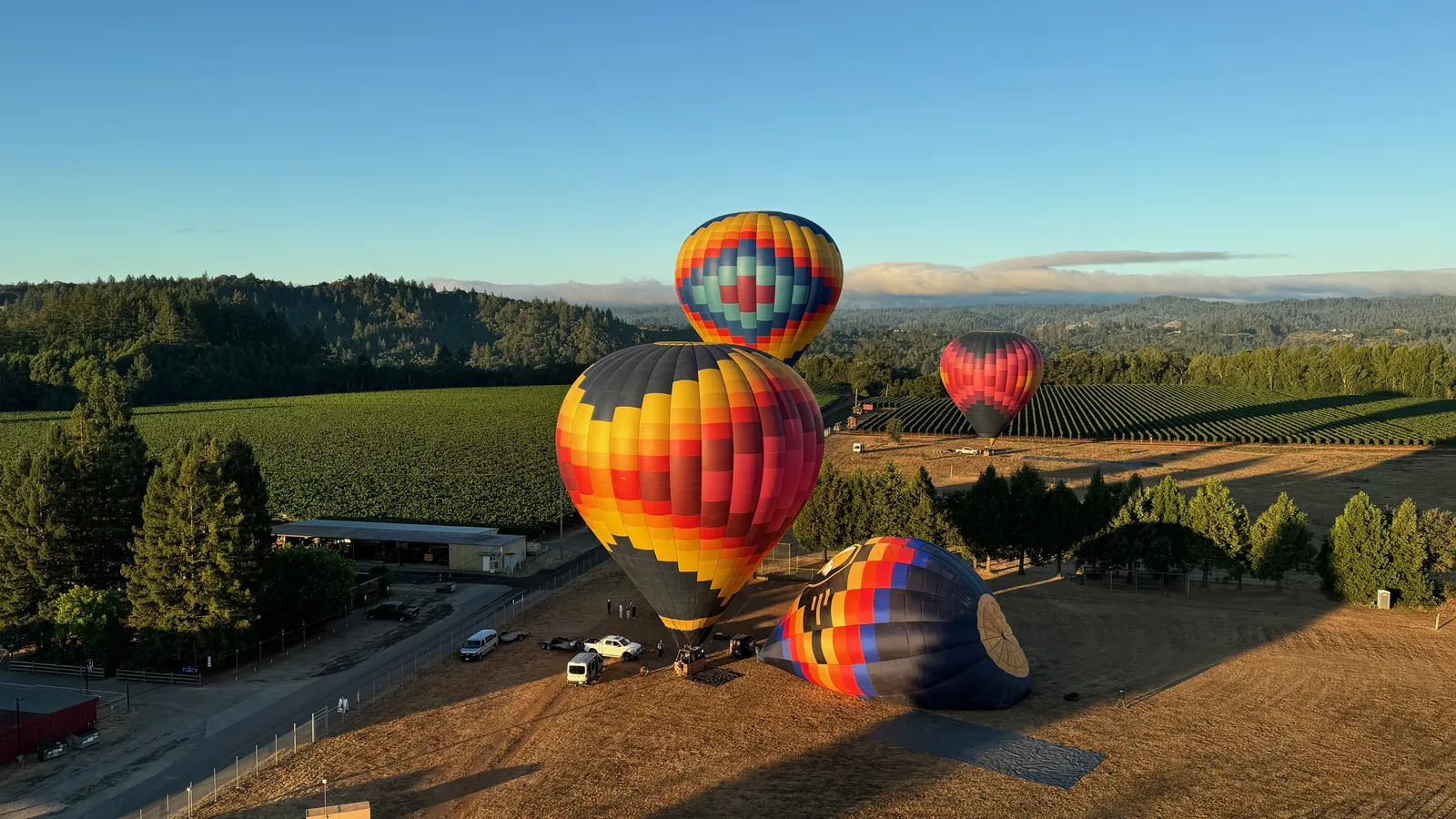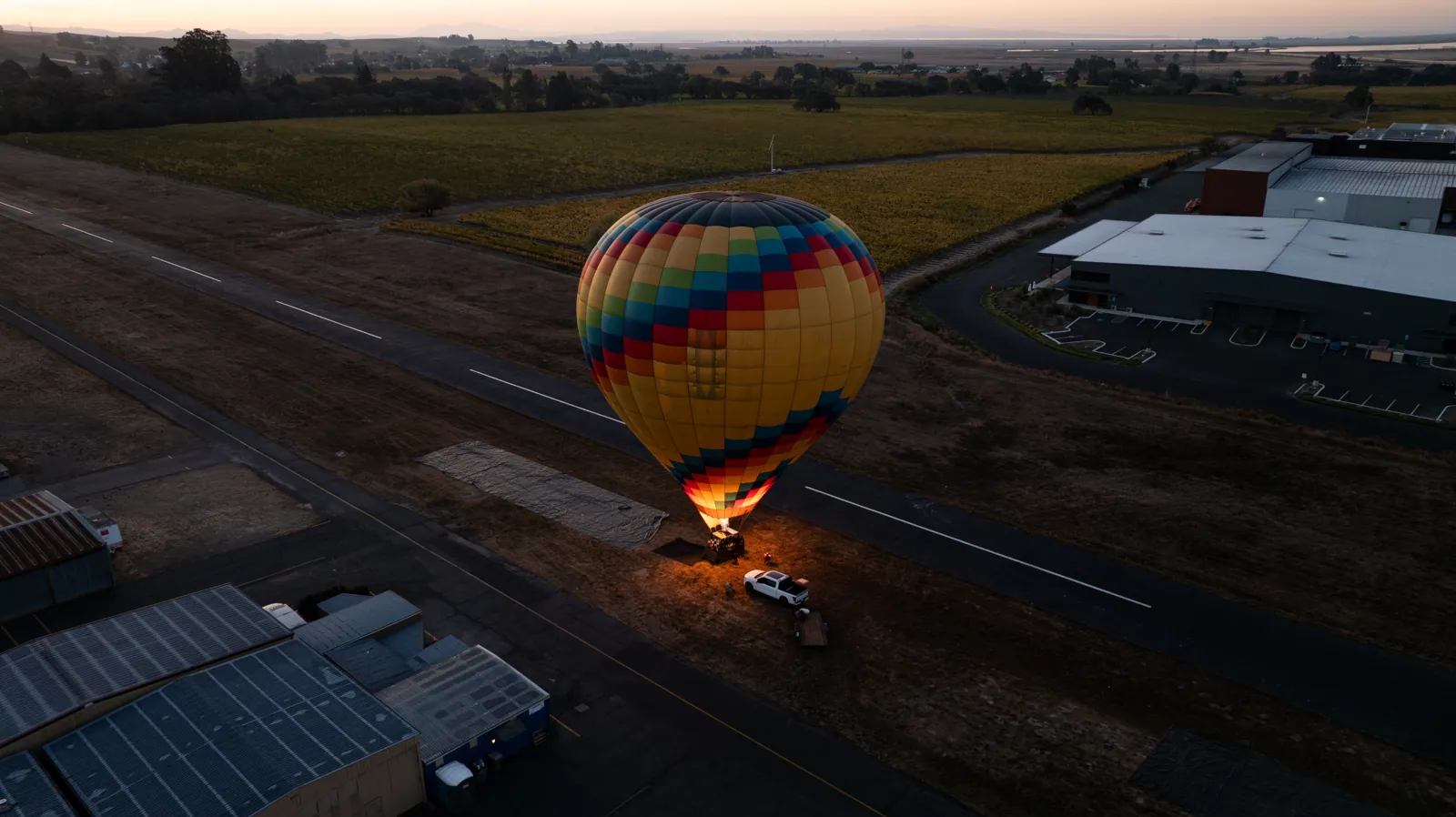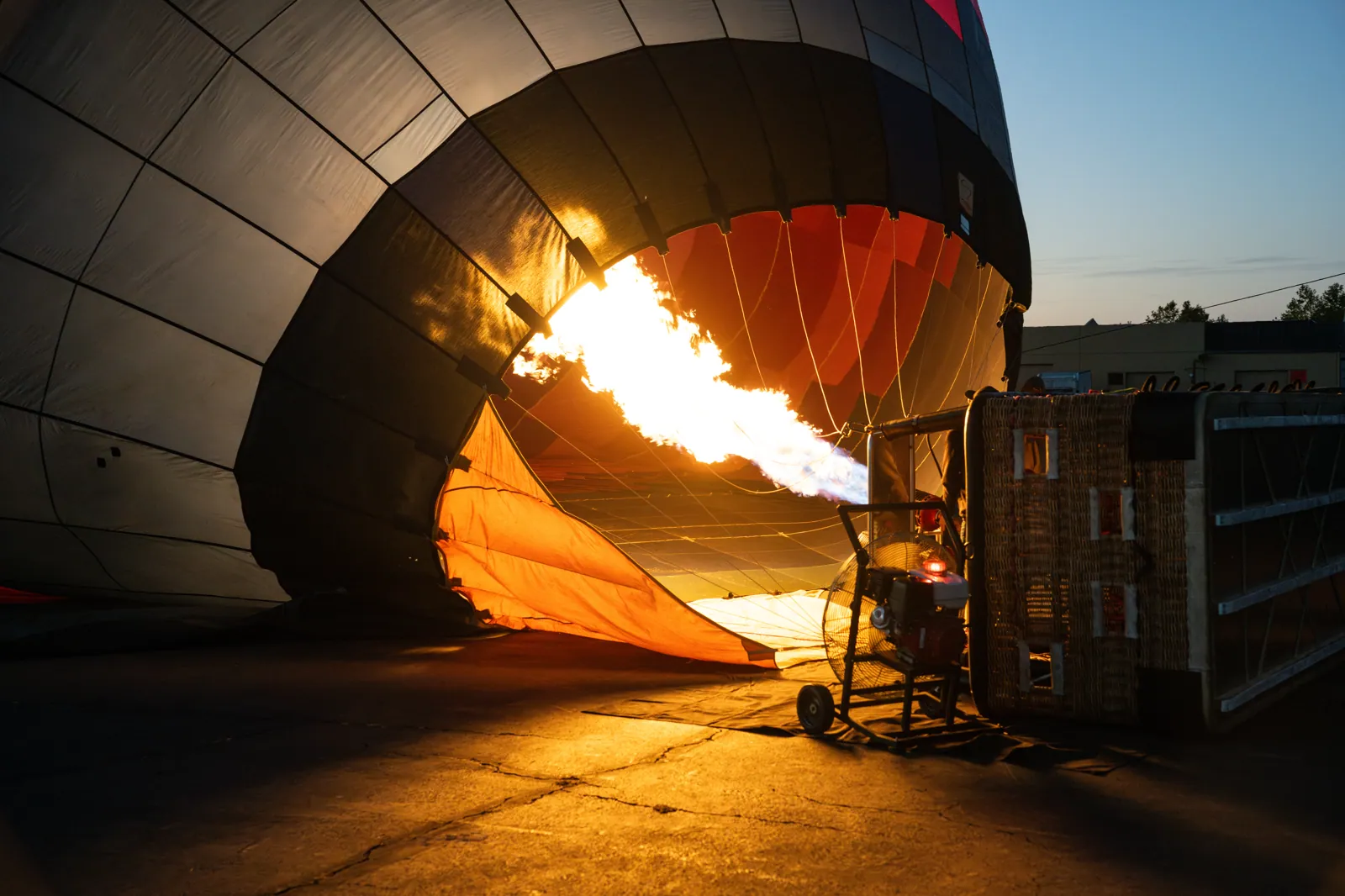
Stand underneath a hot air balloon as it fills with air and the first thing almost everyone says is the same: “I had no idea they were this big.” On the ground, folded into a bag, an envelope looks like a giant duffel. Twenty minutes later it’s towering over you, about as tall as a seven-story building, glowing from the inside. So how big is a hot air balloon, really? Here are the actual numbers — from the everyday balloons we fly over Sonoma to the record-breaking giants that carry thirty-two people at once.
The short answer: about as tall as a seven-story building
A typical sport hot air balloon — the kind most of us ride on a wine-country morning — stands roughly 70 feet tall when fully inflated. That’s about seven stories, or a little taller than a standard telephone pole. Across its widest point, the rounded envelope measures somewhere between 50 and 60 feet in diameter.
Put another way: if you parked a typical balloon next to a six- or seven-story building, the top of the envelope would be right around the roofline. It’s a scale that’s almost impossible to appreciate from a distance and genuinely startling up close.
A few quick reference points for a standard passenger balloon:
- Height inflated: about 60 to 100 feet, with ~70 feet being typical.
- Width: roughly 50 to 60 feet at the widest point.
- Passengers: usually 3 to 8 in a sport balloon, plus the pilot.
How much air fits inside a hot air balloon?
This is where the numbers get fun. A standard sport balloon holds somewhere between 65,000 and 105,000 cubic feet of heated air, with a very common size landing right around 90,000 cubic feet. That one balloon contains more air than a typical three-bedroom house holds in total volume — many times over.
To wrap all that air, manufacturers stitch together close to 1,800 square yards of rip-stop nylon — roughly a third of a football field’s worth of fabric — into dozens of vertical panels called gores. It’s surprisingly light for its size, but when it’s full of hot air it can lift a basket, burners, fuel tanks, a pilot, and several passengers off the ground.
Why does it take so much air? Because hot air is only slightly lighter than the cool air around it. Each cubic foot of heated air provides just a small amount of lift, so you need tens of thousands of cubic feet working together to get a loaded basket airborne. The bigger the load you want to carry, the bigger the envelope has to be. If you’ve ever wondered how that heated air actually translates into a climb, we cover it in how high do hot air balloons fly.
How does something this big pack away?
Here’s the part that really surprises people: once the morning is over, all of that vanishes into a bag. When the envelope cools and the crew squeezes the air out, a 90,000-cubic-foot balloon collapses down and packs into a single large stuff-sack roughly the size of a household refrigerator. The basket, the burner frame, and the propane tanks ride along too, and the whole rig fits on a small trailer or in the back of a van.
It takes a few people and a bit of muscle to roll and pack an envelope neatly — watching the crew “milk” the last air out of 1,800 square yards of fabric is part of the fun of the morning. The entire system is engineered to be enormous in the air and compact on the ground, which is exactly what makes a balloon so portable for the chase crew that follows you across wine country.
How big is the basket?
The basket — pilots call it the gondola — is smaller than people expect relative to that towering envelope, but roomier than it looks from the ground. A basket for a small private flight might be about 4 feet by 3 feet, while a larger shared basket is partitioned into several compartments to hold more passengers comfortably and keep everyone balanced.
Baskets are still woven from wicker and rattan, and for good reason: the material is strong, surprisingly flexible, and absorbs the gentle bump of landing far better than metal would. Size matters here more than most first-timers realize — a roomier basket means more space to move, better photos, and an easier view over the edge. We’re a little obsessed with this, which is why we keep our baskets less crowded; there’s more on that in hot air balloon basket size and space.
Why a balloon’s size shapes your whole flight
A balloon’s dimensions aren’t just trivia — they directly affect your morning. A larger envelope can carry more weight, which is how big commercial baskets fit a dozen or more people. But there’s a trade-off: the more passengers packed into a basket, the less elbow room each person gets.
That’s the balance we’ve chosen on purpose. Flying less-crowded baskets means everyone gets a spot at the edge, room to lift a camera, and an unobstructed view of the vineyards sliding by below. It’s the difference between feeling like you’re on a crowded elevator and feeling like you’re floating on a private balcony in the sky. Smaller, well-managed loads also make for smoother, easier-to-control flights — which pairs nicely with the gentle pace we describe in how fast do hot air balloons go.
The biggest hot air balloons in the world
If a 90,000-cubic-foot balloon already sounds enormous, hold on. Special-shape and commercial balloons routinely run 150,000 to 300,000 cubic feet to lift bigger baskets and more passengers.
And then there are the giants. The largest passenger hot air balloon ever built is the Cameron Z-750, with a volume of 750,000 cubic feet — big enough to carry 32 passengers in one basket. Fully inflated, it stands about 131 feet (40 meters) tall, nearly twice the height of a typical sport balloon.
Bigger still have been built for record attempts rather than rides. When Vijaypat Singhania set the world altitude record in 2005, he flew a custom Cameron Z-1600 with a staggering 1.6 million cubic feet of capacity. That’s roughly eighteen ordinary sport balloons’ worth of air in a single envelope — proof that, when it comes to balloons, “how big” has a very high ceiling.
How big are the balloons we fly in Sonoma?
Ours sit right in that classic, comfortable sport-balloon range — tall enough to turn heads on the launch field at Sonoma Skypark, sized for less-crowded baskets rather than packed commercial loads. It’s the sweet spot: big enough to lift you smoothly over Carneros and the Sonoma Valley with an experienced, FAA-certified pilot, and intimate enough that the flight feels personal, right down to the complimentary champagne toast when you land.
Join-in flights start around $265 per person, and we fly most mornings of the year, weather permitting.
Frequently asked questions
How tall is a typical hot air balloon?
About 70 feet when fully inflated — roughly the height of a seven-story building. Larger commercial balloons can be well over 100 feet tall.
How much air does a hot air balloon hold?
A standard sport balloon holds around 65,000 to 105,000 cubic feet of heated air, with about 90,000 cubic feet being a common size.
How wide is a hot air balloon?
Most measure roughly 50 to 60 feet across at the widest point of the envelope.
What is the biggest hot air balloon in the world?
The largest passenger balloon is the Cameron Z-750 at 750,000 cubic feet, which can carry 32 people and stands about 131 feet tall. Even larger envelopes, like the 1.6-million-cubic-foot Cameron Z-1600, have been built for altitude records.
Does a bigger balloon mean a better ride?
Not necessarily. Bigger envelopes carry more people, but that often means a more crowded basket. We prefer right-sized balloons with less-crowded baskets so every passenger gets room and a clear view.
How many people fit in a hot air balloon?
A typical sport balloon carries 3 to 8 passengers plus the pilot. The very largest commercial balloons can carry 30 or more.
Come see one up close (and from the inside)
Numbers only get you so far — there’s really no substitute for standing under a balloon as it inflates, then lifting off in it a few minutes later. As a family-owned company flying less-crowded baskets from the closest launch sites to San Francisco, we’d love to show you exactly how big, and how gentle, a hot air balloon can be.
Book a join-in flight · Explore our packages · Call us at 707-819-9223
Sonoma Ballooning — wine country from above, at the speed of the wind. Voted #1 in both Sonoma and Napa.
Ready to see it for yourself?
Sunrise join-in flights over Sonoma & Napa wine country — champagne toast included, from $265.
Book a Flight · $265