Every time we pop a bottle of local sparkling wine at the end of a flight, we’re taking part in a tradition that’s almost 250 years old. Guests are often surprised to learn that the hot air balloon is one of humanity’s oldest flying machines — it carried people into the sky a full 120 years before the Wright brothers ever left the ground.
So when was the hot air balloon invented, and how did we get from a smoky paper bag in the French countryside to sunrise flights over Sonoma wine country? Here’s the short, surprisingly wild history — including the real reason we hand you a glass of champagne when you land.
The short answer
The first hot air balloon to carry people flew on November 21, 1783, over Paris, France. It was built by two brothers, Joseph-Michel and Jacques-Étienne Montgolfier, and it changed what humans believed was possible. Everything else — airships, airplanes, spaceflight — came after.
Who invented the hot air balloon? The Montgolfier brothers
The Montgolfier brothers ran a paper manufacturing business in Annonay, France. As the story goes, Joseph was watching laundry billow upward as it dried over a fire and became fascinated by the idea that “lighter” hot air could lift things. The brothers began experimenting with lightweight bags of paper and fabric held over a flame.
On June 4, 1783, they gave their first public demonstration, sending an unmanned balloon nearly 6,000 feet into the sky in front of a stunned crowd. Word spread across France almost overnight. Nobody had ever seen anything like it.
First passengers: a sheep, a duck, and a rooster
Before risking a human life, the next test flight carried a decidedly different crew. On September 19, 1783, a balloon rose carrying a sheep, a duck, and a rooster — launched in front of King Louis XVI and the royal court at Versailles. The animals landed safely, proving that creatures could survive aloft. (We like to think of them as ballooning’s first, slightly confused, passengers.)
The first human flight: November 21, 1783
Two months later, history was made. On November 21, 1783, Jean-François Pilâtre de Rozier, a physics teacher, and François Laurent, the Marquis d’Arlandes, lifted off from the Château de la Muette on the edge of Paris. They flew for about 25 minutes, covered roughly five and a half miles, and landed safely — the first humans ever to fly.
Among the witnesses was the American statesman and inventor Benjamin Franklin, then living in Paris. When a skeptic asked what use this strange new invention could possibly have, Franklin is famously said to have replied, “What use is a newborn baby?”
Just ten days later, on December 1, 1783, Jacques Charles flew the first hydrogen balloon — proof of how fast the world had caught balloon fever.
Ballooning crosses the Atlantic to America
The new sky craze reached the young United States a decade later. On January 9, 1793, French aeronaut Jean-Pierre Blanchard made the first balloon flight in North America, lifting off from a Philadelphia prison yard in front of a crowd that included President George Washington. Blanchard even carried a letter from Washington, making it arguably the first piece of airmail in American history. That date is still marked today as National Balloon Ascension Day.
Why we toast with champagne after every flight
Here’s our favorite part of the story — and the origin of a tradition we’re proud to keep alive.
In those earliest days, balloons would drift over the French countryside and come down wherever the wind decided, often in farmers’ fields. The trouble was that farmers had never seen a balloon before. To them, a giant, roaring, fire-breathing shape descending from the sky looked less like a marvel of science and more like a dragon — and some met the early balloonists with pitchforks.
The clever solution? The aeronauts began carrying bottles of champagne. When they landed, they’d present the bubbly to the alarmed locals as a peace offering — proof that they were human beings, not monsters, and an apology for dropping in on the crops. The gesture worked, and a tradition was born that balloonists around the world still honor today.
We think it’s the best custom in all of aviation, which is why we’re the only balloon company in our area that still offers a complimentary champagne toast after every flight. When you raise your glass at the landing field, you’re toasting with more than 240 years of ballooning history. (If the post-flight celebration is your favorite part — and for many guests it is — you’ll enjoy The Magic of Champagne Breakfasts After Hot Air Balloon Rides in Sonoma.)
How far ballooning has come — and what hasn’t changed
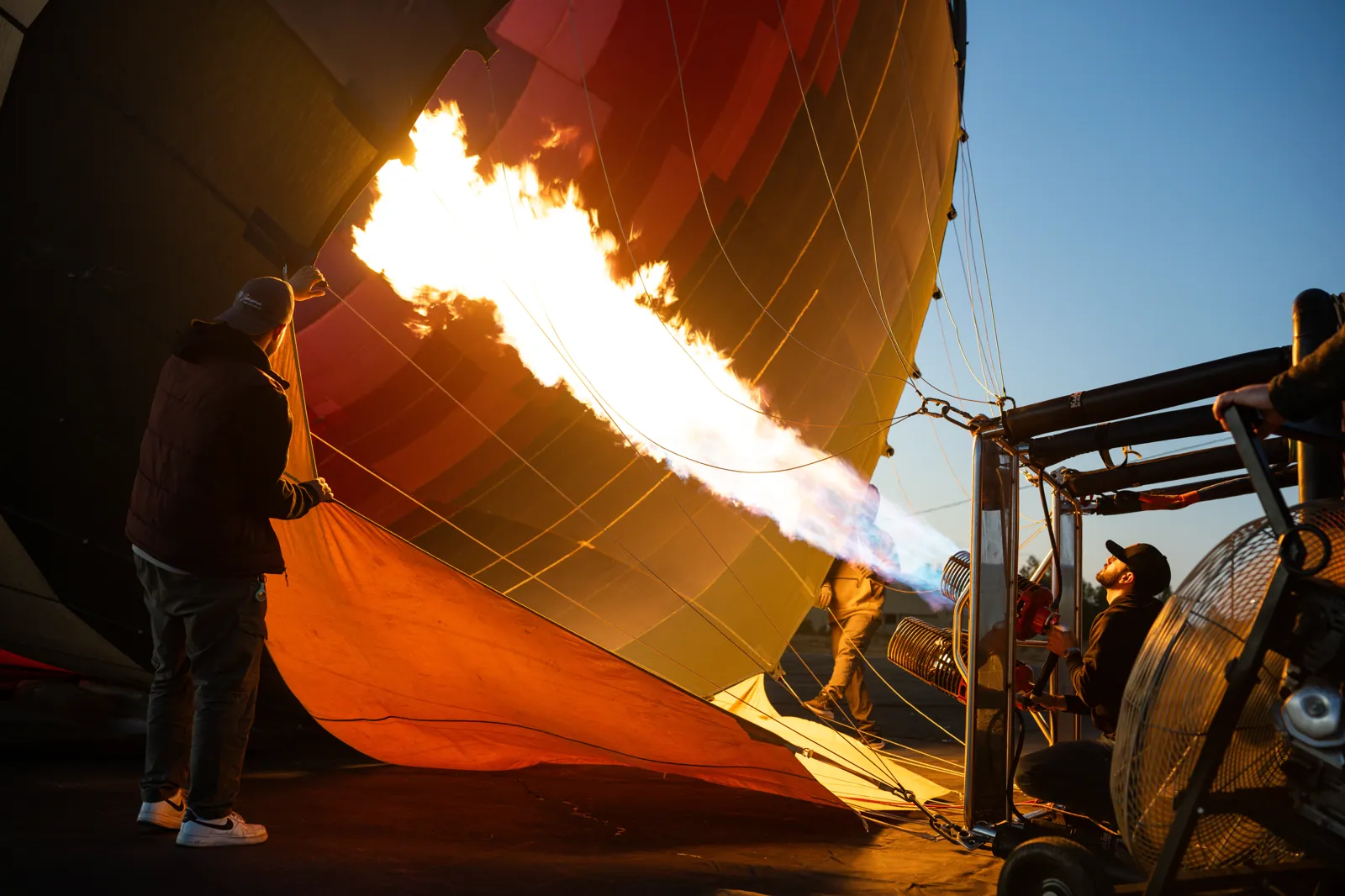
Modern balloons would amaze the Montgolfiers. Today’s envelopes are made of strong, lightweight nylon, propane burners give pilots precise control, and FAA-certified pilots train for years before flying guests. The science of reading wind layers to navigate is far more refined than anything possible in 1783.
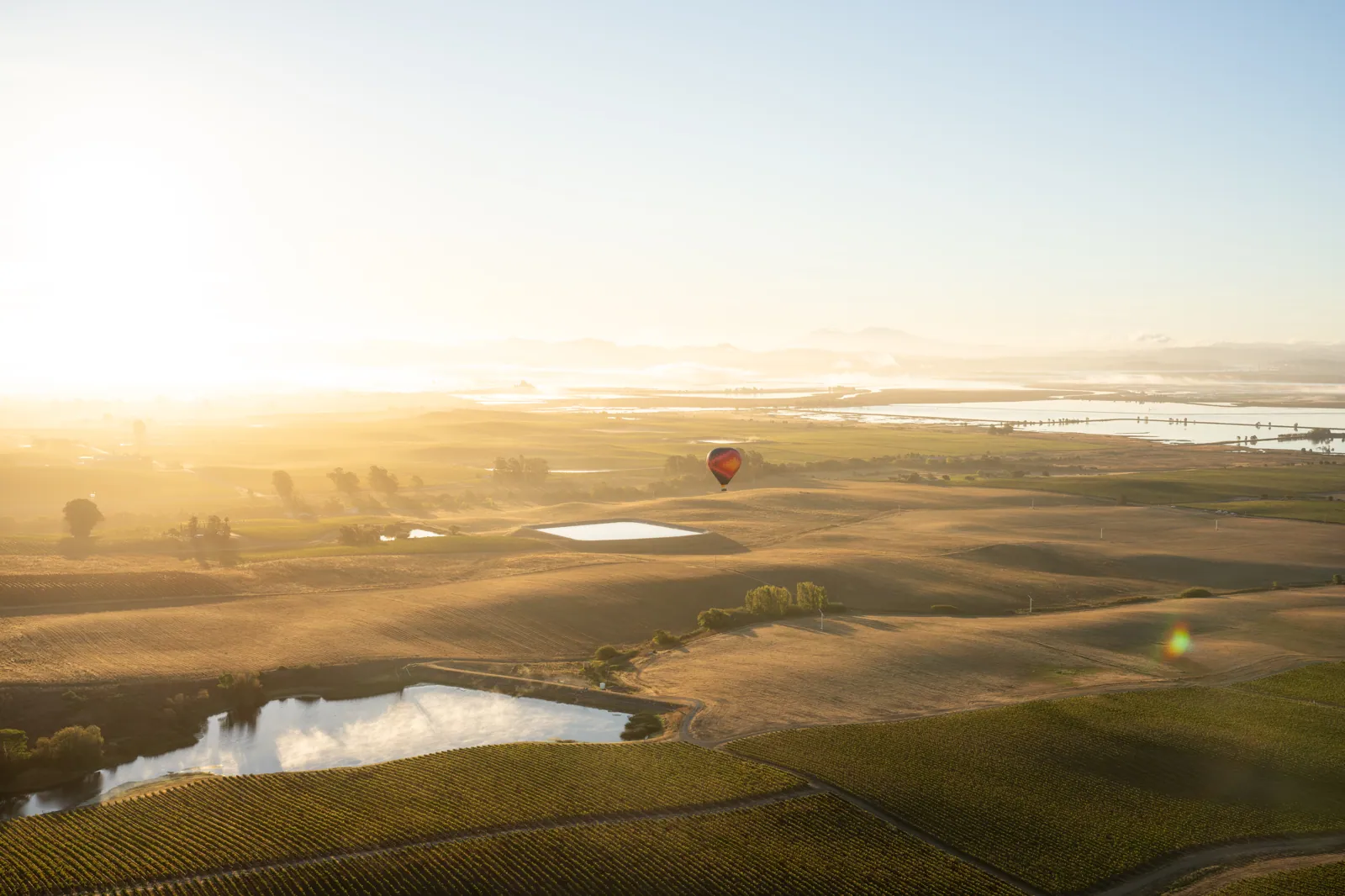
And yet the heart of it is exactly the same: heat, air, a basket, and the quiet wonder of leaving the ground. The first passengers felt that magic over Paris, and you’ll feel the very same thing drifting over the vineyards of Carneros at sunrise. Some experiences simply don’t need improving.
Frequently asked questions
When was the hot air balloon invented?
The first public flight of an unmanned Montgolfier balloon was June 4, 1783, and the first crewed flight was November 21, 1783 — both in France.
Who was the first person to fly in a hot air balloon?
Jean-François Pilâtre de Rozier and the Marquis d’Arlandes, who flew over Paris on November 21, 1783.
When did the first balloon fly in America?
January 9, 1793, when Jean-Pierre Blanchard flew over Philadelphia as President George Washington watched.
Why do you drink champagne after a hot air balloon ride?
The tradition dates to 1780s France, when balloonists offered champagne to wary farmers whose fields they landed in. It became a celebratory ritual that continues worldwide — and one we keep alive with a complimentary toast.
Where can I experience this tradition near San Francisco?
Right here in Sonoma. We’re the closest wine-country balloon ride to San Francisco, and every flight ends with the champagne toast.
Become part of the story
Two and a half centuries after that first flight over Paris, the invitation is still the same: leave the ground, see the world from above, and celebrate with a glass at the landing. We’d love to welcome you aboard.
Book a join-in flight · Explore our packages · Call us at 707-819-9223
Sonoma Ballooning — taking wine country to new heights. Voted #1 in both Sonoma and Napa.
Ready to see it for yourself?
Sunrise join-in flights over Sonoma & Napa wine country — champagne toast included, from $265.
Book a Flight · $265